

Amphibians of Wisconsin
While amphibians are the most endangered class of animals worldwide, Wisconsin is something of a bright spot — our native frogs, toads, and salamanders are faring better than their counterparts across the globe. That doesn't mean they're without threats, but it does mean that Wisconsin landowners have a real and meaningful opportunity to support thriving local populations right on their own property.
By Denise Thornton
Cover Image Credit: Illinois DNR
Worldwide, amphibians are in trouble. According to The Nature Conservancy, amphibians are the most endangered class of animals, with 41 percent of species facing extinction — as opposed to about 26 percent of the world’s mammal species, and about 15 percent of bird species. Yet, “in Wisconsin,” says John Peterson, biology professor at UW-Platteville, “our amphibians are doing fairly well.” Peterson’s research focuses on conservation and diseases of amphibians and reptiles. “In Wisconsin, Cricket frogs are our only endangered amphibian, but they are doing okay in the southern part of the state.”
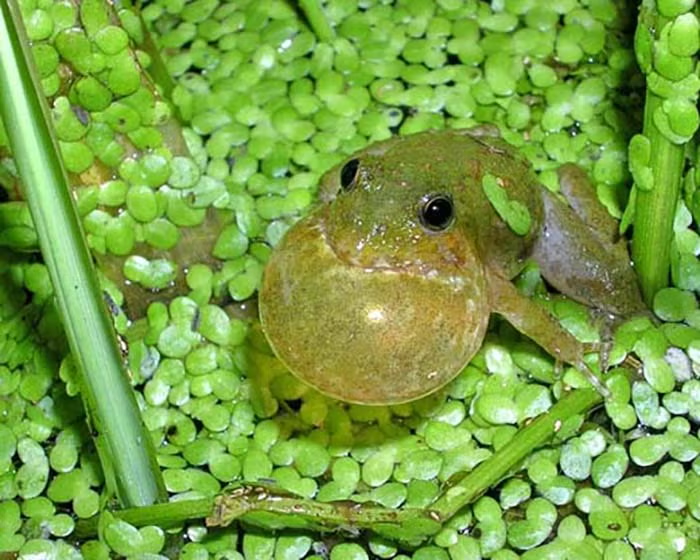
Photo Credit: WDNR
Nonetheless, Wisconsin’s herps (the common term for amphibians and reptiles among the herpetologists who study them) are facing the same threats as those in other areas. The biggest problem has been habitat loss caused by human activities, and this has been compounded in the past 30 years by a fungus, Chytridiomycosis, which covers a frog’s skin and smothers the creature. Herps are also imperiled by warming temperatures, hotter and drier summers, severe storms, and wildfires.
Amphibians are a valuable part of the environment. According to Rori Paloski, conservation biologist and herpetologist with the WDNR, “Though they are small, herps provide major benefits through what they eat, such as invertebrates, which includes many mosquitos. If you have a pond, amphibians will eat most of the mosquito larva. And amphibians, in turn, provide food for other animals. Also, Tiger salamanders, Blue Spotted salamanders and Spotted salamanders, these three species spend most of their lives underground and help keep the soil healthy.”
HOW TO KEEP YOUR HERPS HAPPY
To make your land more welcoming to amphibians, it is good to know their life cycles. Most amphibians start as soft, jelly-like fertilized eggs under water. The spawn (fertilized egg masses) can be seen in spring. They hatch into tadpoles or salamander larvae that are fully aquatic and feed on aquatic plants and debris. Later they develop limbs and lungs and move to the land as adults.

Photo Credit: Greg Schechter/Wikimedia Commons
Amphibians can be found in forested areas and near ephemeral ponds, or as they are often called, vernal pools. “One of the best things landowners can do in their woodlands is to identify areas that might have vernal pools,” says Peterson. “This would be out of the flood plain, but could be anywhere in woods that has a depression in the ground. Vernal pools can be in areas with a slope, where there is a small flat area, or in a ravine, and in areas where there is an intermittent stream that appears with rain or rising groundwater. Oxbows in creeks can also be good, especially if there are no fish that might eat the eggs.”
“The gold standard,” says Paloski, “is a wetland (ideally fishless) that is connected to forested or prairie landscape. Leopard frogs love open grassland, and Tiger Salamanders use open grassland. A moist woods with some open areas is a good mosaic of habitats. Leopard frogs can travel one to two miles in the summer to forage for food. Other species only go a few feet from the water.”
If you want to make or enhance an existing pond, make sure it is at least three feet deep so that it will not freeze solid, since many amphibians overwinter underwater. The WDNR has a PDF on constructing landscape ponds.
Peterson says that a good pond for amphibians will need a gradually sloping shoreline. Paloski adds that the edge of a pond can not be lined with big rocks. Both juveniles and adults of some species will have trouble getting in and out.“Imagine you are a half-inch long toad,” she says. “They don’t jump like a frog would.” Also, Reed Canary Grass or any invasive shoreline vegetation will deter amphibians.
While you may hear frogs from a cattail-filled ditch at the edge of a parking lot, some frogs and most all salamanders need a more pristine habitat. “Many amphibians need connectivity between uplands and wetland habitat,” says Paloski. “We do most of our salamander surveys looking at vernal pools, and those can be difficult to create because in nature, those areas will dry up by the end of the year. That process helps keep them fishless.”
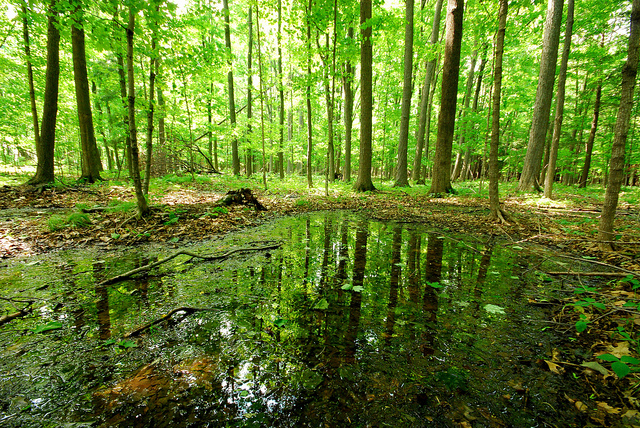
Photo Credit: Wisconsin Wetlands Association
Vernal pools can be shallower and tiny. Amphibians won’t overwinter there, but salamanders and wood frogs can come in the spring, lay eggs that progress to adults, and leave.
“Let nature happen,” advises Paloski. “If leaves fall in, that’s great cover for the little larvae in the pond. Vernal pools are filled with leaves, and they often have downed logs. The messier — the better.”
“We have 12 species of frogs in Wisconsin, and they can overwinter very differently,” notes Paloski. “Toads are in their own group because they are a little stronger and like sandy soils. They will burrow down in the soil and get below the frost line. About half our frog species overwinter in water, and they need a pond that does not freeze to the bottom. Some bigger species, like tree frogs and green frogs, have tadpoles that overwinter and may not metamorphose into adult frogs till their third summer in the water. Cricket frogs cannot withstand freezing temperatures or being under water, and they have to find micro-climates like crayfish burrows or cracks and crevices along the shoreline.”
Intriguingly, spring peepers, tree frogs, and wood frogs can actually freeze solid in the winter. They have a natural glucose-based anti-freeze in their blood, and they turn into frog-shaped ice cubes. When it gets warm again, they thaw out, their heart starts beating again, and they hop away into the next year of their life.
“I love picking up frogs and looking at them,” says Paloski. “But I tell people to make sure they have no DEET bug spray, sun screen, or even regular lotions on their hands. Amphibians will absorb it through their skin. I once watched a woman, who I knew had bug spray on her hands, pick up a few tadpoles. Within five seconds, they had died or were unconscious because she had so much DEET on her hands. It happens that fast.”
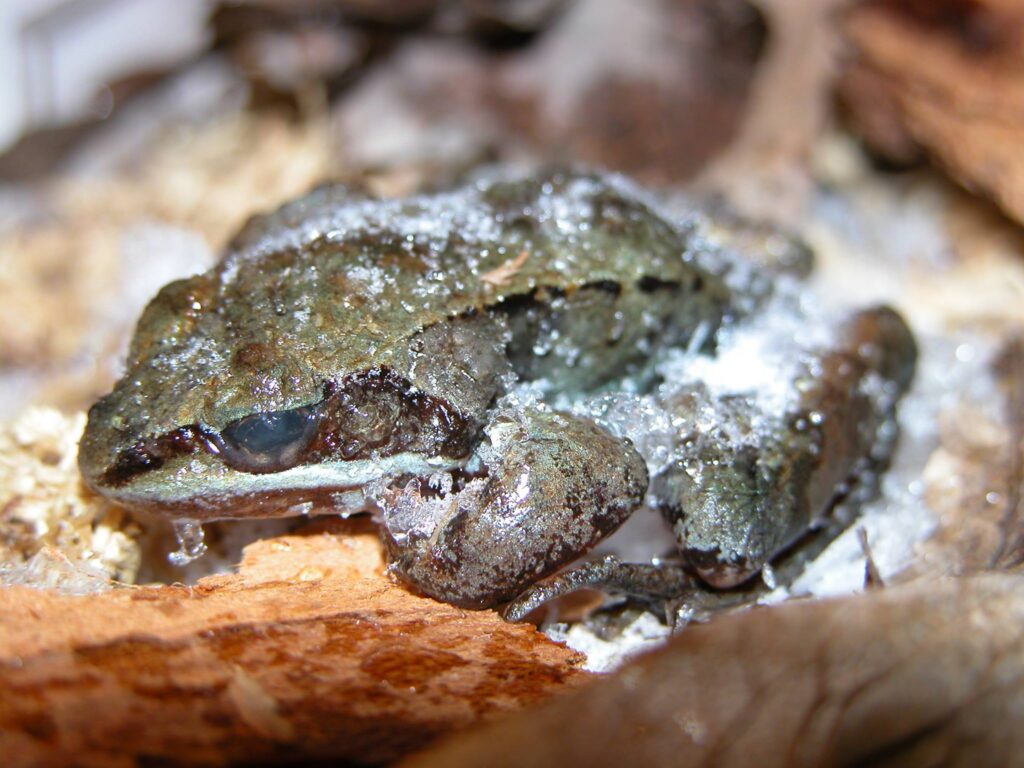
Photo Credit: U.S. Fish and Wildlife Service
Paloski also recommends looking up online any herbicide you are considering. “Do your research and don’t just read the herbicide labels. A lot of herbicides are listed as being safe for fish, bumble bees and mammals, but may not have been tested on amphibians so they don’t mention them. With a little research, it’s possible to find a decent, non-toxic herbicide.”
Other ways to keep your herps happy are:
1. Reduce the amount of area that you mow. Most amphibians like the cover provided by tall grass or pockets of shrubby vegetation.
2. It also helps to keep fallow fields and grasslands clear of woody over story vegetation — especially keep natural areas that occur near ponds.
3. Keep some brush or woodpiles on your property, and leave fallen logs, leaf litter and other ground debris in natural areas. Many species use these as cover. Wood frogs, newts, spotted salamanders and spring peepers usually prefer a semi-mature to mature woodland with ample ground debris.
WISCONSIN’S FROG AND TOAD SURVEY
Wisconsin’s Frog and Toad Survey is the longest-running amphibian project in North America. Started in 1981, it became a statewide program in 1983. A salamander survey is currently being developed.
The F&T Survey began because people were noticing declines in several Wisconsin frog species. Long-term monitoring was needed. “Amphibian populations naturally fluctuate, even in a pristine environment without major human impacts,” says Paloski. “You need at least 20 years of data, or you might catch a brief downturn or upswing. F&T Survey Volunteers (for which there is a waiting list) visit 10 predetermined sites three times each season. We are getting close to 50 years of data now.”
Also, landowners who wish to get involved can contribute to a newly-added state phenology survey. “For this survey, we ask volunteers to select a single pond, wetland, or stream, ideally on your land or perhaps in a park that you walk past frequently,” says Paloski. Participants can survey at least half an hour after sunset two or more times per week in April, May, and June.
“Though people have to learn the calls of our state frogs, it’s easy. There are only 12 — a fraction of the number of calls birders must learn,” Paloski says. The information from this new survey will be used to help understand changes in the times frogs are starting to call, and the length of their calling period. This helps track abundance as well as whether species are expanding or declining.
The WDNR offers field guides for Wisconsin amphibians and reptiles. There are also detailed county maps available online of where amphibians and reptiles are likely to be found in our state.
Another way to learn more, and engage with our state’s amphibians is to join a Natural Resources Foundation of Wisconsin field trip. They are offering 280 field trips this year, and eight will feature amphibians and reptiles. Registration opens at noon on April 8, and some of the trips are likely to be filled quickly.
One of the joys of springtime in Wisconsin is the sound of frog calls swelling in the night air. It’s a vital reminder of why we live here, and with some attention and care, it will be a pleasure for generations to come.