The Importance of Pollinators in Your Woods
Pollinators play a big impact in your woods, and are important to consider in your year-round woodland plans. Learn more about attracting pollinators and the role they play.
By Denise Thornton
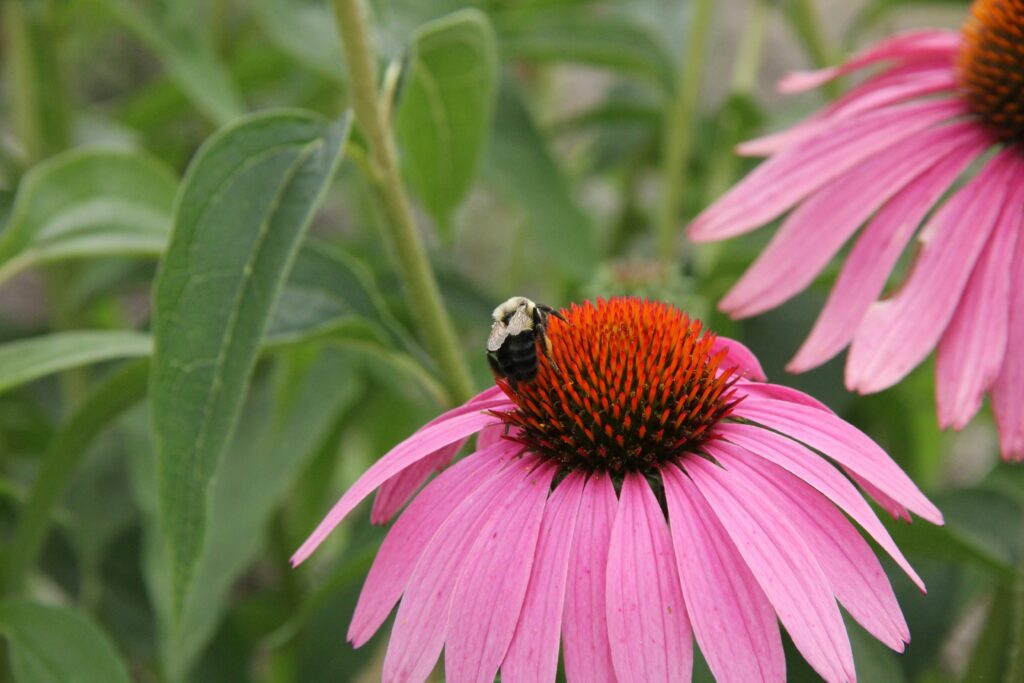
One welcome sign of Spring is the sight of a bumble bee queen, fresh from winter’s hibernation, gathering pollen from the first blossoms.
That busy bee, along with managed honeybee colonies and other native pollinators, are under pressure from increasing urbanization, some modern agricultural practices, pesticides, climate change, and invasive plants. Natural areas, including your woodlands, can play a crucial role as refugia for native pollinators. In fact, those pollinators will keep your woods healthier.
A healthy woodland will also promote productive agriculture in nearby fields. Research has shown that visitation of native pollinators to soybean flowers is higher closer to a forest, with greater pollinator presence leading to increased yields.
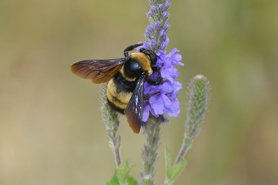
According to the USDA, three-fourths of the world’s flowering plants, along with about thirty-five percent of the world’s food crops depend on animal pollinators. So, managing your woodlands for healthy pollinator populations is a boon to both ag land and natural areas. It’s a win-win management practice.
If you are new to encouraging pollinators in your woodlands, the best way to start is to assess what you already have and what you might be missing. Rachel Padour works with The Wisconsin Bumble Bee Brigade, Wildlife Habitat Council, and recommends that “you have to get into the mind of the pollinator and think: where do I want to spend the winter and be close to spring flowering resources, and at the same time shelter from predators who might want to get into my honey pots? Only honeybees make a lot of honey, but bumble bees do store nectar for their young in small honey pots that skunks and raccoons find delicious. They not only eat the nectar but also the larvae, which are full of protein.”
To look for pollinators, Padour says, “Go to the flowers at the right time of day. If you are looking for bumble bees in summer, go out earlier in the morning. Their hairy bodies get hot in the afternoon. Also, when it is cooler, they are slower and easier to spot. Sit quietly, and do not wear bug spray or perfume – they can detect that and will avoid you.”
PROMOTING PLANT DIVERSITY
“Pollinators are a critical component of a healthy ecosystem,” says Judy Cardin, educator for the WDNR Wisconsin Bumble Bee Brigade and administrator of the Wisconsin Bumble Bee Observers Facebook page. “It starts with the soil and native plants growing in the woods. Those plants have co-evolved with the native pollinators that live in the woods with them. Certain flowering woodland plants require a specific species of bee species to pollinate them, and on the bee’s side of it, they require that specific flower type to provided pollen for their young. Every single type of native flower, shrub or tree supports specific species of bees as well as pollinating moths, beetles, and butterflies.”
And when it comes to the overstory, “manage your woods for tree diversity,” says Kass Urban-Mead, a Xerces Society pollinator conservation specialist. “Some trees don’t bloom every year, so you want to make sure there is always something that pollinators can eat.”
HABITAT STRUCTURE
Sunny areas that provide floral and nectar resources are crucial to many woodland pollinators. Bees need to go back and forth all day from their food source to their nests. Examples of beneficial gaps and edges that provide sun can include forest roads and power line corridors. “It can be helpful to allow strips of grasses and wildflowers to grow between the forest edge and roads”, suggests Christie Sullivan, New York Department of Natural Resources in the Environment.
Consider creating a feathered edge by thinning trees 50 feet into the woods, with a wildflower edge just outside the trees. “Allowing sunlight in along the edge can increase bumble bee abundance and the total number of pollinator species present,” Sullivan adds.
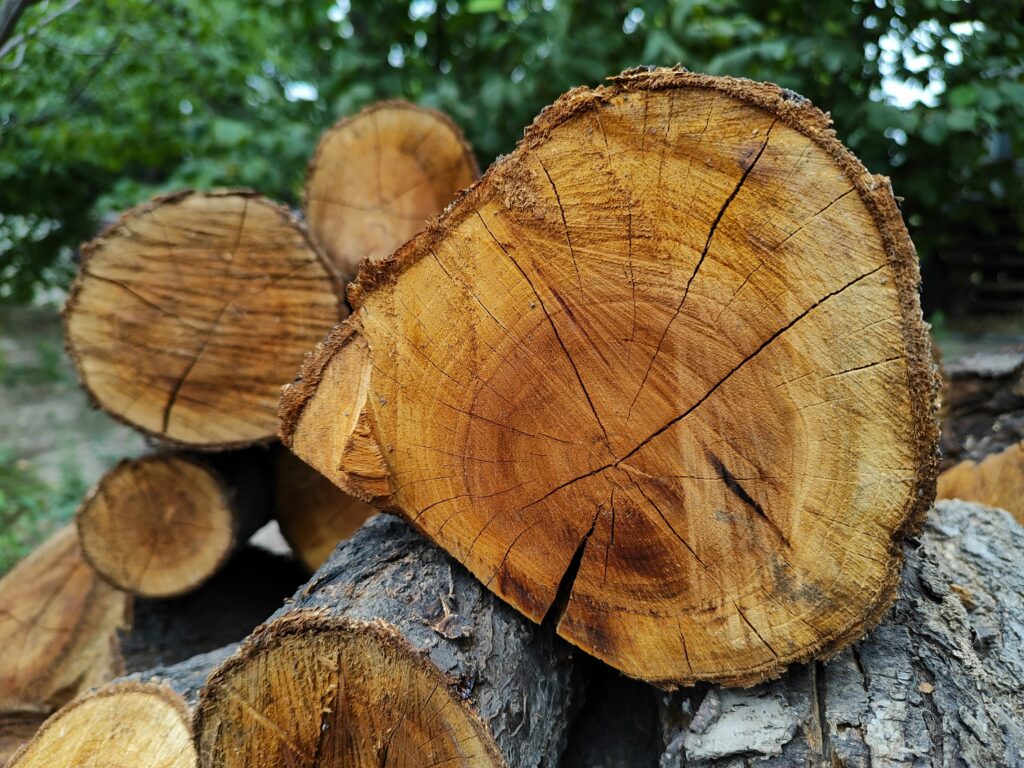
Log landings can be managed as pollinator habitat. It’s helpful to leave log and brush piles and treetops on the ground and reseed around the cleared space with perennial wildflowers. The crevices between logs and under bark are a good overwintering habitat. And allow some bare ground with loose soil to persist along the edges. Some pollinators need to burrow, and mason bees can find mud there to build their nests.
You can create your own sunny areas. One study showed that five-acre patch cuts with thirty to one hundred percent overstory tree removal increased bee abundance in response to raspberry growth and factors like temperature, bare soil, etc. But this much clearing can also have drawbacks, with the bee’s gain coming at the expense of native moths.
The number of different kinds of moths declined following a shelterwood cut (15 percent removal), though the poplulations recovered in three years. Removing eighty percent of canopy trees meant moths took much longer to recover. “Woody plants can support about ten times as many butterflies and moths as herbaceous plants do,” says Sullivan. “They use woody plants not only for food, but also for shelter and pupation and as a nest resource for adults.” Oaks in particular can support over 500 species of moth caterpillars.
The canopy of your woods offers many benefits to pollinators. Leafcutter Bees use tree resins. And the honeydew excreted from sap-sucking insects found on trees can be collected by bees, especially in periods of drought.
Pollinators also use trees as mating sites. Tree tops provide shelter from wind and temperature extremes. Canopy pollen is an important part of pollinators’ spring diet, according to Urban-Mead.
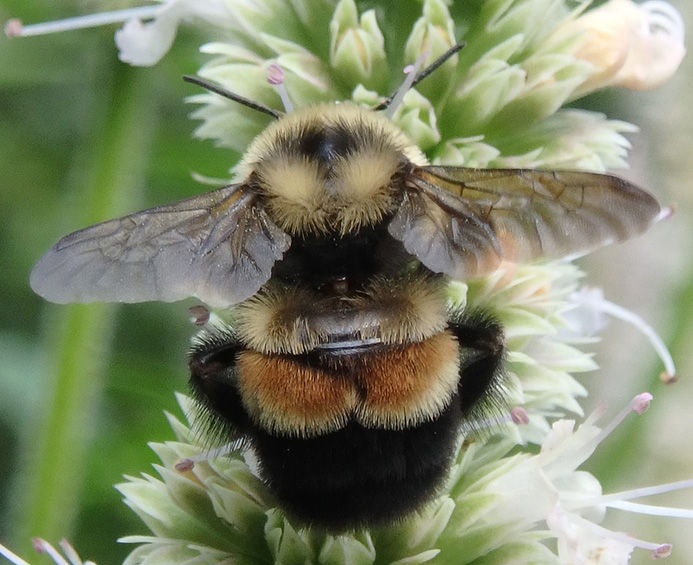
Rusty Patch Bumble Bees (an excellent pollinator of wildflowers, cranberries and other important crops including plum, apple, alfalfa and onion seed) are one of many bee species that use woodland habitat for their nests. Though they are listed as endangered by the U.S Fish and Wildlife Service, Wisconsin is one of only a few states that still has a population. “Over the last few years, Rusty Patch nests have been discovered in Wisconsin, and they have nearly all been found in woodland environments,” says Cardin. “They like to nest in abandoned rodent burrows. The best thing for pollinators like bumble bees, moths and butterflies is to leave the leaves, stems, rodent holes, and grass mats of vegetation undisturbed. This is where they are nesting, hibernating and sheltering. Woodlands are precious native habitat.”
A study of removing invasive honey suckle encouraged regrowth of native geraniums, which provide a specialized nectar that was shown to encourage the return of specific species of miner bees. This kind of invasive brush not only suppresses spring ephemerals, but it also lowers the ability of the forest to recreate canopy.
ALL YEAR LONG
SPRING: Even though some woodland pollinators may be moving to other habitats later, they depend on woodland flowers in the spring. That is why it is important to protect spring ephemerals from deer if possible. Deer have a strong preference for native species, even if they occur at low densities, according to Urban-Mead.
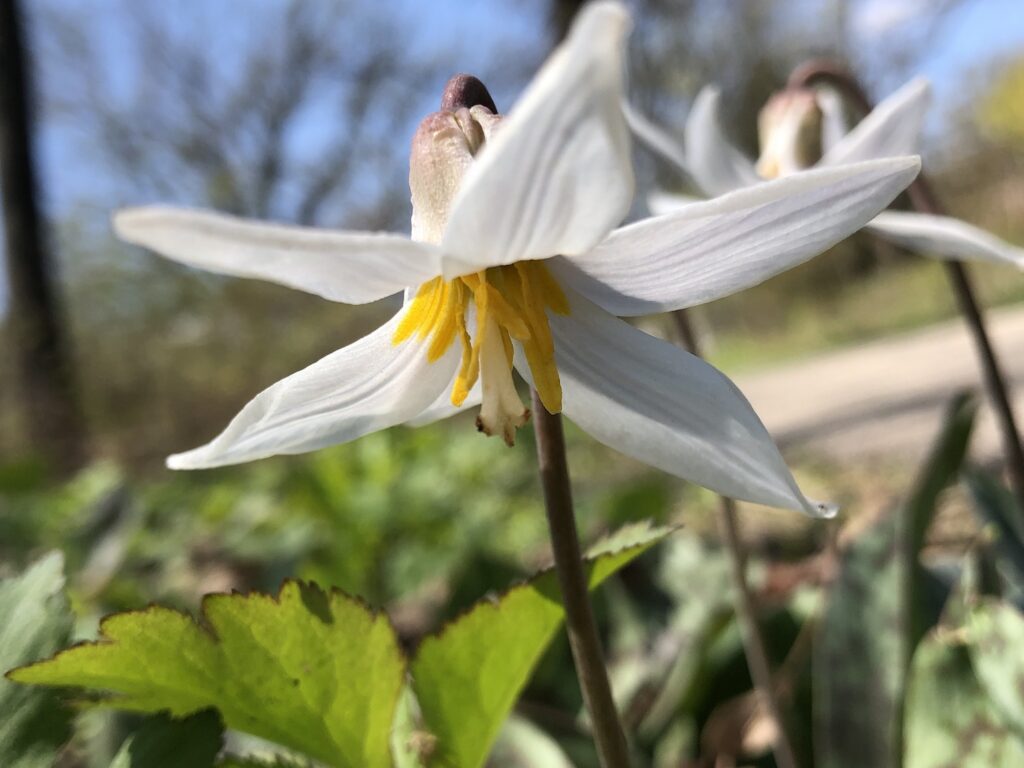
In a list compiled by Cardin, April and May flowers for bumble bees and others include Dutchman’s Breeches, Virginia Bluebells, Virginia Waterleaf, Wild Geranium, Trout Lily (there is a trout lily bee that can only survive on Trout Lily pollen), Jacob’s Ladder, Shooting Star, and Large Bellwort. “They are so important to bumble bee queens starting their colonies, and so much better than non-native flowers,” says Cardin. “People say they see bees on non-native plants like dandelions. Bees will use them if no native flowers are available, but dandelion pollen does not have enough protein, and when it is fed to larvae, they will develop into healthy adults.”
Another good source for pollinators in spring are flowering trees like American Plum. Two groups of Currants and Gooseberries bloom in April, and Maple trees also bloom then. “There are actually a lot of trees and shrubs in woodlands that, along with early spring flowers, are so much better for native pollinators than things like dandelions,” says Cardin. Shrubs include Missouri Gooseberry, American Black Currant, Prairie Willow, Pussy Willow, and Serviceberry.
SUMMER: Bumble bee workers care for the young and forage for food, each individual living for only about a month. Cardin says that successful nests replace workers and increase nest size to produce a healthy number of new queens and males by the end of summer. Her list for summer woodland flowers includes Sweet Joe Pye Weed, Dwarf Bush Honeysuckle (a native bush), Hairy Wood Mint, Giant Yellow Hyssop, as well as blackberry and black raspberry thickets.
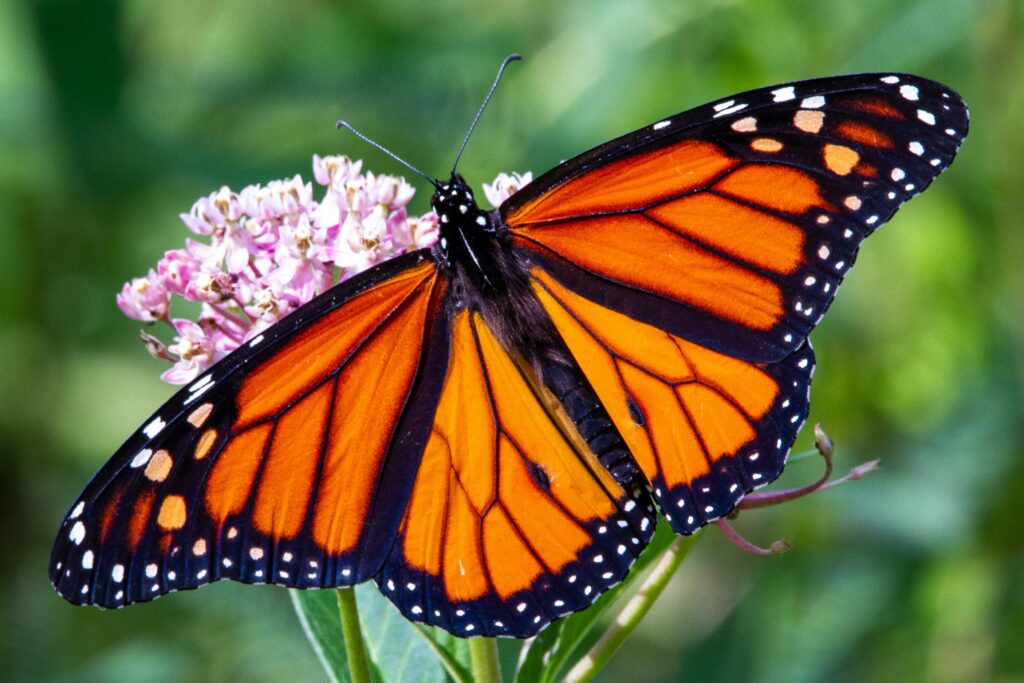
FALL: Fall is an important time for migrating pollinators like butterflies, as well as the new bumble bee queens that emerge in the fall. They must feed heavily so they have enough body fat to hibernate through the winter. If they don’t find enough food in fall, there won’t be new bumble bees in the spring. Fall flowers that can be found and added in woodlands include Late Figwort, Zigzag and Elm-leaved Goldenrod, Heartleaf, Blue Wood, Drummond, and Short’s Asters, and Giant Yellow Hyssop.
This is also the time when queen bumble bees are checking every little darkened cavity for nest sources. Bumble bees who establish nests in forests have been shown to have more successful colonies the next year than those who nest in meadows and fields.
WINTER: Pollinators that overwinter in Wisconsin need to find places they will be protected from the elements and other animals while they wait out the cold.
Leave dead trees, both standing and fallen. Protect duff and leaf litter for nesting on the forest floor. Keep piles of brush and logging debris. Hover Flies, an important pollinator — second only to bees — are attracted to decaying wood. Burrowing pollinators may find shelter among the dirt and roots of tipped-up trees. They look for existing beetle burrows, that they may dig out a little farther and deposit a pollen ball. Pollinators may find shelter under a bit of loose bark 60 feet up a tree. They may also overwinter in dead stems that are cut on the top, such as raspberry canes.
WOODLAND BURNS
Studies of woodland burns show that they can reduce some invasive plants and invigorate the growth of native flowers. But, says Cardin, in dense woodlands, make sure you know what the pros and cons will be for pollinators. “In all burns, you want to leave substantial refugia,” she says. “That gives pollinators somewhere they can move from the burned area. The impact of fire on bees nesting underground is not as significant as it is on above-ground nesters. There is some insulation that occurs in burrows. About 60 percent of species nest underground, but that means that 40 percent of bees could lose their nests in a burn.”
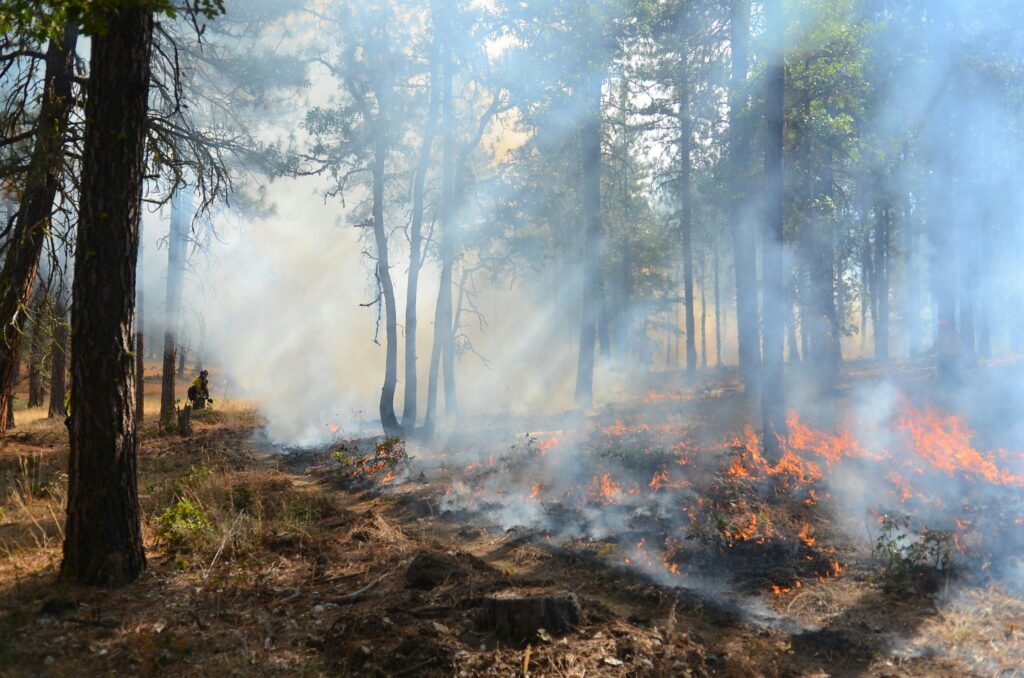
Timing of burns is important for pollinators, Cardin says. Burning in late March to early April or in the late fall can minimize the number of pollinators killed. Pollinators like moths and caterpillars can be vulnerable at ground level. “It’s a balancing act,” says Cardin, and the way to promote healthy plant rejuvenation through burning, as well as to preserve nesting pollinators, is to maintain refugia. “You need to look at the situation on your land and make the decision to the best of your ability.”
PESTICIDES
Some common herbicides used to control invasive plants contain glyphosate. Though numerous studies have shown that they don’t cause direct mortality unless you spray it on a pollinator, Cardin says that other studies have indicated exposure to glyphosate can result in pollinators having problems with the development of their larvae, and still other studies have shown that bees cannot find their way home after being exposure.
Other herbicides are potentially more toxic and less well studied. Christine Sullivan of the New York Department of Natural Resources in the Environment advises that you minimize your use of herbicides and focus on timing. “Do any application after bloom time. That way you won’t have pollinators visiting the toxic blooms.”
“Pollinators are a critical component of our ecosystem,” says Cardin. “there are estimates that over the past few decades we have lost up to 30 to 40 percent of earth’s insect population.’ We are continuing to lose over two percent every year. Do the math and protect your pollinators.”
With pollinators under threat, tending to your woods with their success in mind is more important than ever. Call it the latest buzz in forest management.