
The Latest on Chronic Wasting Disease
Stay up to date on the newest news on CWD in Wisconsin, and how you can help the deer herd, but keep yourself safe.
By Denise Thornton
Chronic Wasting Disease (CWD) was identified in Wisconsin’s deer population in 2002 near Mount Horeb, and ever since it has been steadily spreading throughout the state. Research into CWD is ongoing in Wisconsin. Here is an update on what is known about this increasingly widespread contagion.
WHAT IS CWD
CWD is a fatal, infectious nervous system disease that affects deer, elk, moose, and reindeer. One of several known prion diseases (pronounced pre-on, with a long e), it occurs when normal proteins in the brain change shape and begin to clump together.
“If a deer gets CWD, they will die of it unless they die of something else first,” says Daniel Storm, a Wisconsin DNR deer research scientist. “But it is not an acute disease. It can take a year-and-a-half or more from when a deer takes the prions into their body until they die. Outwardly, for the vast majority of the infected period, they appear healthy — though they are infectious and shedding prions to their environment and to other deer the whole time.”
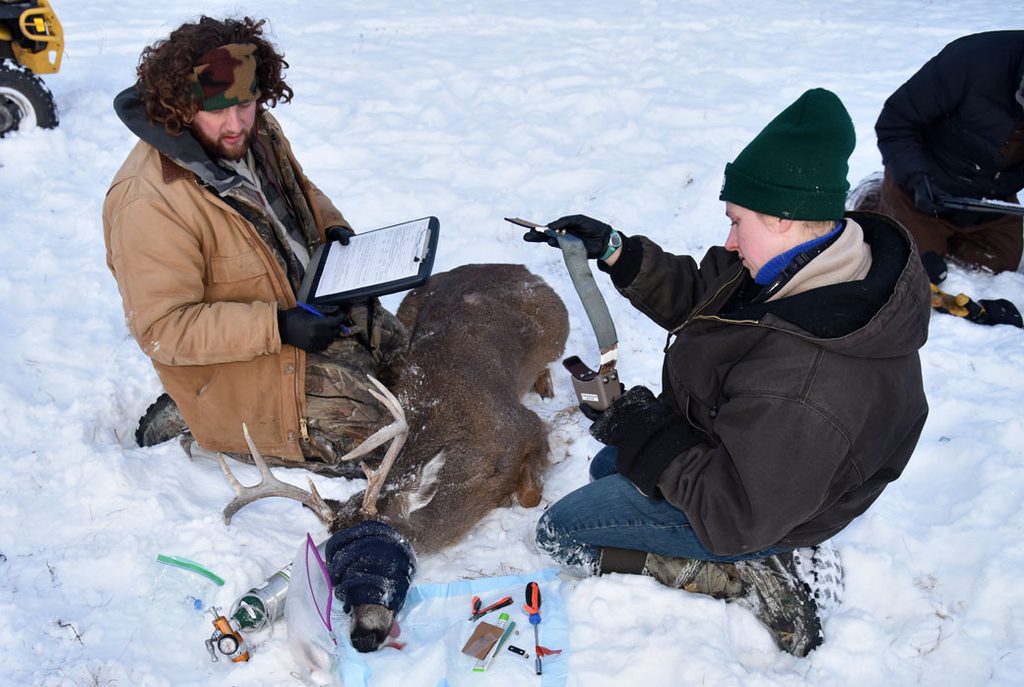
“It’s only the last few months prior to death that deer with CWD really start to decline in health. Then they deteriorate rapidly. It is really dramatic,” Storm says. “They totally exhaust their fat reserves, and their muscles start to waste away. Every deer we have found that died of CWD, died of starvation or a combination of starvation and a secondary infection like pneumonia. One of the symptoms of end stage CWD is extensive drooling and trouble swallowing. They may be getting saliva or food into their lungs instead of down the trachea”.
“We don’t know what causes the starvation,” Storm continues. “It probably involves reduced feed intake, but we have found dead animals with food in their stomach or in their mouths. Deer are ruminants, and their four-chambered stomach is a very complex ecosystem. In the end, they will lay down or fall down, and never get up again.”
CAN HUMANS GET CWD?
According to the U.S. Centers for Disease Control and Prevention, there have been no cases of CWD in people. It’s not known if people could get infected with CWD, but CWD is related to Bovine Spongiform Encephalopathy (BSE), also known as Mad Cow Disease, which has spread to humans.
The CDC recommends:
If you’re hunting in areas with CWD activity, follow these steps to reduce your risk of contact with the disease:
- Do not shoot, handle or eat animals that look sick or are acting strangely.
- Do not touch or eat meat from animals found dead.
If you’re field-dressing a deer or handling meat:
- Wear latex or rubber gloves.
- Avoid handling its internal organs, especially the brain or spine.
- Do not use knives or other tools you use in your kitchen.
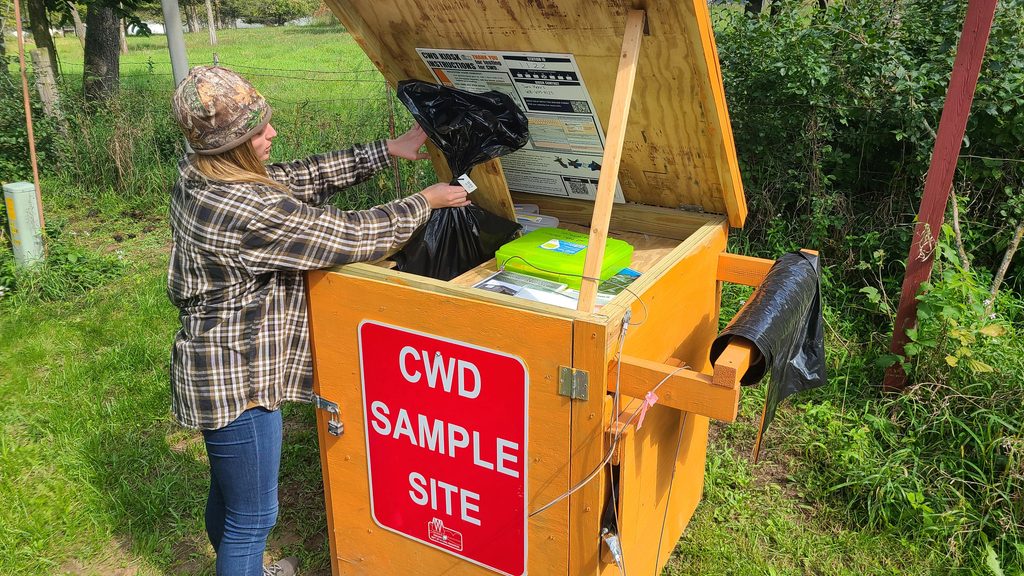
Storm says that hunters can have any deer they harvest tested for CWD. “You can drop off the head of the deer or have the lymph nodes extracted for testing, and fill out a short form that says who the hunter is and where the deer was harvested. The sample will be tested for prions, and the hunter will be notified within an average of nine days.”
CWD sampling is available statewide, and testing through the DNR is free for deer harvested in Wisconsin. You can find CWD Sample and Disposal Locations on the WDNR website.
HOW IS CWD SPREAD
The disease is spread through bodily fluids, making salt licks and feeders a hotbed for new infections. Yearling bucks who leave to join new herds can spread CWD to new areas, according to a Wisconsin Public Radio report.
“Experimental situations and studies have shown that CWD can be spread directly from the saliva of an infected deer into the mouth of an uninfected deer,” says Storm. “Infection has also been demonstrated to be spread through the environment. When infected deer were removed from their pen, and then uninfected deer were put into that pen, those deer contracted CWD. What we don’t know yet is how significant each of these different ways of infection are — deer licking each other versus taking it up from their environment.
HOW MANY DEER ARE INFECTED?
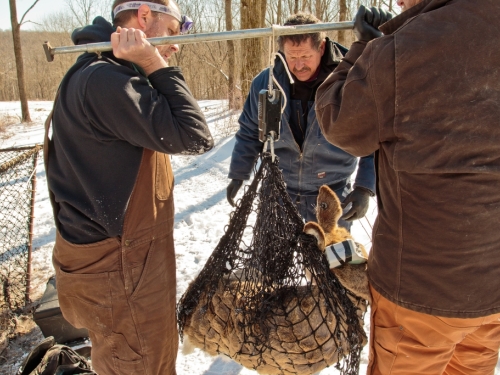
The Southwest Wisconsin CWD Deer Study has gathered data by collaring deer and testing them. The deer are then monitored as to where, when, and how they died. Of the 17,759 deer sampled throughout the state during the 2025 hunting seasons there were 2,006 samples testing positive. Most (87%) of these positive samples were in the Southern Farmland Zone.
WHAT LAND OWNERS CAN DO
CWD thrives where deer populations are very abundant and harvest rates are low. That means keeping the deer herds in check will help.
“To fight it, you want to remove infected deer from the landscape as quickly as you can,” says Storm. “But you can’t tell if a deer is infected until you test it. That means increasing the removal of all deer. This will also ensure the longterm health of the herd. In the farmland parts of Wisconsin, we could harvest many more deer than we do.”
“It’s a crude tool,” Storm admits, “but it is sorely needed for a variety of reasons. Many Wisconsin woodland owners are very aware of the challenges of over abundant deer. It’s an advantage to have a healthy balance between the number of deer and the carrying capacity of the habitat. Reducing deer population won’t completely eliminate CWD but it will help. And if you don’t yet have CWD in your area, it should lower the odds of disease establishment and the rate of it spreading — just by increasing our deer harvest.”
Meanwhile, the number of deer hunters in Wisconsin has been falling. A new study tracking individual hunter participation from 2005-2022 found that in this 18-year span, Wisconsin had 80,000 fewer hunters, a decline of 13 percent.
If you are not yet a hunter, the WDNR has learn-to-hunt programs. Check the WDNR website to learn more about about these programs.
“Another avenue,” says Storm, “is to be mentored by someone you know. Check the website for details on Mentored Hunting Law.
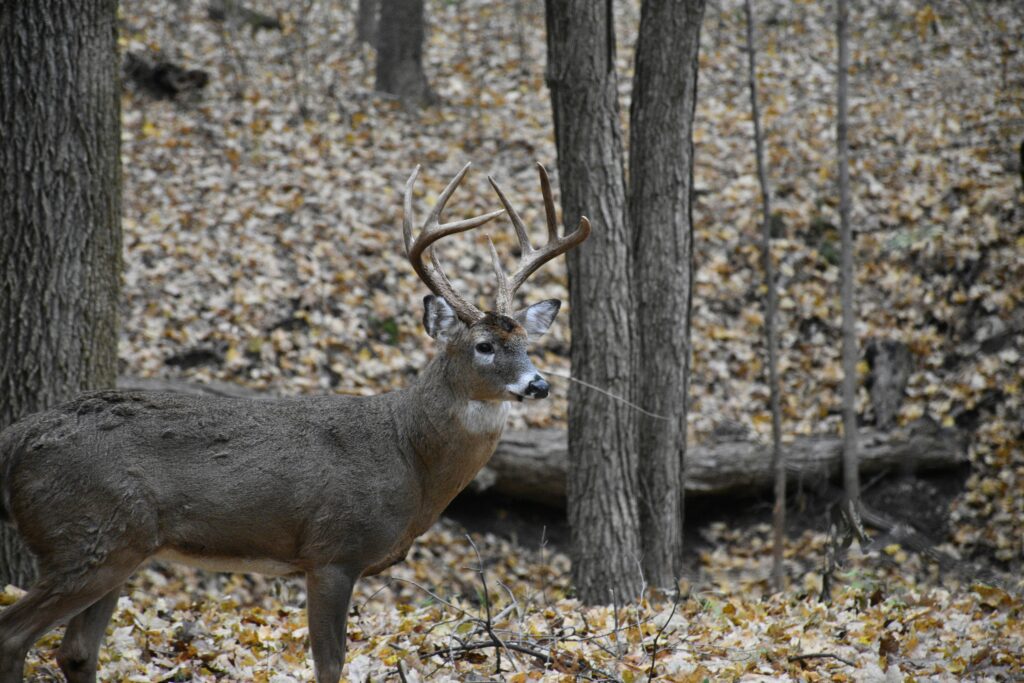
If you do not wish to hunt yourself, Storm suggests finding a hunter who is looking for a place to hunt. “There are people who want to hunt,” says Storm, “but they don’t have a location.’ And if you do like to hunt, but cannot take advantage of all the deer resource on your property, Storm suggests that you may be able to find additional hunters. “Landowners can do a vetting process and place whatever stipulations they want — like what days, and where they can and can’t hunt. I can understand how landowners can be leery of allowing people on their property with guns,” Storm says, “ but with a little effort, you can work through that.”
Storm has suggestions for what to do with the extra deer you harvest:
1. Eat more venison, but only after it has been tested. “A lot of Wisconsin hunters view venison as a novelty,” says Storm. “It could become more of a staple for them. A household of two people could easily eat two or more deer each year.”
2. Hunters can help Wisconsinites in need. “Donation programs are underutilized in many areas,” Storm says. Since the DNR’s deer donation program began in 2000, hunters have contributed over 100,000 deer that have been processed into four million pounds of ground venison and distributed to local food pantries. Hunters can donate the entire deer free of charge or retain the head and antlers if desired. For more details on how and where to donate your deer, check the WDNR website.
CWD is not going away, but adding more venison to your own diet or providing ground venison to local food pantries could be a win-win way to make a difference in controlling this tragic and dangerous disease.