Old Growth Forests Past and Present
Old growth foresters are beautiful, but do you know the true characteristics? In this article, learn about the characteristics of old growth forests, and how you can manage your woods for characteristics.
By Denise Thornton
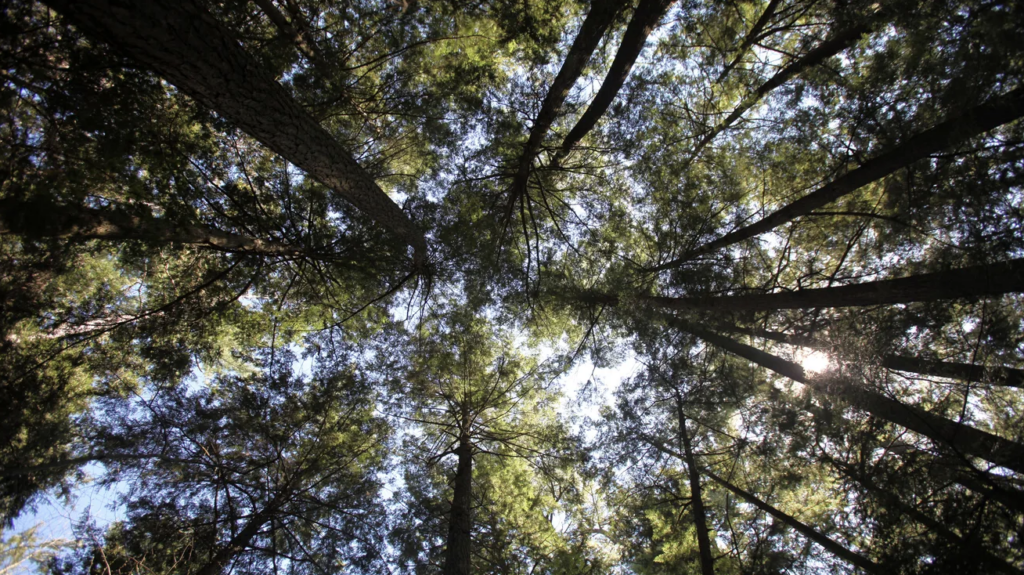
The grandeur of Wisconsin’s lost pre-European-settlement forests is hard to imagine. “Many of the pines cut during Wisconsin’s clear-cutting period were about 400 years old. Some were more than 500 years old, over 200 feet tall, and 10 feet in diameter,” says John Bates, author of Our Living Ancestors: The History and Ecology of Old-growth Forests in Wisconsin and Where to Find Them. Today, 46 percent of Wisconsin’s land area — more than 16 million acres — is forested, but less than one percent of it is considered to be old-growth.
Having lasted for thousands of years, our old-growth forests were more than majestic. They had evolved a deep resilience and provided much better wildlife habitat than most current woodlands. But while they are irreplaceable, all is not lost. “Restoring an old-growth forest takes a long time,” says Brad Hutnik, WDNR Silviculturist and Forest Ecologist, “but there are things we can do right now to restore some of the valuable elements that old-growth forests had.”
BENEFITS OF OLD-GROWTH FOREST
“If we can keep the patterns and processes of things that were here in the past, those durable characteristics are more likely to be around in the future,” says Hutnik. For example, large, very old trees have survived many environmental challenges like weather, disease and insects, and their genes may be more resilient to such hazards.
“We don’t have a lot of animal species in Wisconsin that are necessarily dependent on old-growth woods,” Hutnik says, “but American martens are probably linked to habitat qualities of old growth that we just don’t have right now. American martens are in decline, but we are working to keep them around. Part of that is learning the habitat characteristics they need, and how we can produce them in our management.”
As Aldo Leopold said in A Sand County Almanac, “To keep every cog and wheel is the first precaution of intelligent tinkering.” Returning lost cog and wheels in some situations might mean adding old-growth characteristics to our forests.
“We can tailor restoration to mimic disturbance while also keeping an eye on what we want to regenerate.” says Hutnik. If there are species predicted to do better in the future, you might want to consider favoring them.” Recommendations for species that have been projected by the USDA Northern Forests Climate Hub to have increased habitat suitability by the end of the century are available on line.
OLD-GROWTH FOREST CHARACTERISTICS
There are many ways to define what constitutes an old-growth forest as it changes between cover types and natural communities. In general, old-growth forests share some characteristics. These include:
* Advanced stand age
* Diversity of tree sizes from saplings to large saw timber
* Presence of very old and large trees
* Presence of large, standing dead trees
* Increased amounts of fallen trees and coarse woody debris
* Pit and mound topography and presence of canopy gaps
HOW TO REINTRODUCE OLD-GROWTH ELEMENTS
Most of our current forests are between 80-100 years old. “That is pretty old for a human, but for a forest — it’s still young,” says Paul Catanzaro, who helped produce the study Restoring Old-Growth Characteristics to New England’s Forests. Hutnik interviewed him on the podcast Silvicast that he hosts with Greg Edge. “The good news is that we are on the front end of developing this regrowth, and we have options.”
Hutnik agrees, “We can set the stage for having better conditions in these stands for the future. How do we engage with our forest to honor what they were while still achieving our broad societal goals? Many of us need income from our land. People worry that the idea of creating old-growth characteristics means taking wood off the market. We need to find ways to support old-growth characteristics as well as the possibility of harvest into a sustainable model for both people and forests.”
PASSIVE VERSUS ACTIVE MANAGEMENT
“We can take a passive approach in some areas, where we allow natural disturbances to be the main driver,” says Catanzaro. “If you take that approach you will limit your salvage after disturbance. Natural disturbances will create the mortality and lead to the old-growth characteristics over the next century. Maybe we don’t salvage everything. Leave some tip up mounds. These disturbances moves the clock forward. I recognize there is a safety and economic aspect to salvage. But this is where we have a gradient. Do the best you can on a parcel by parcel decision making. This creates a benchmark to say – this is what happens when you do nothing. The passive approach can also maximize the storage of carbon, which is important as well.”
Adding old-growth characteristics is possible on a variety of scales. It doesn’t have to be all or nothing. You could leave a few legacy trees in a stand, or choose to leave an entire stand as a passive approach within a larger forest. You could even leave yourentire property alone — or anywhere in between.
“The passive approach works best on sites that don’t have a lot of invasive plants or really big deer populations,” Catanzaro notes. “If there are a lot of invasive plants and other challenges, that woods may get stuck in a successional loop. In those cases, you may want to take a more active approach.”
Catanzaro estimates it would take 100 years or more of a passive approach to reach the tree-size target that defines old-growth forest, but he estimates using silviculture with two to three crown thinnings, you can achieve that large tree target and all that comes with it in half that time.
“Remember, using silviculture can make the tree bigger, but does not make the tree older. We can change forest density and focus resources on certain main trees, but truly old trees have different bark and different crown architecture based on the types of disturbances they have survived. They have wonderful decay columns that woodpeckers and insets love. Still, silviculture can be used to speed up old-growth characteristics that help achieve some of the benefits that landowners are interested in.”
“It’s important to remember,” says Hutnik, “big trees aren’t the only characteristic of old growth. Big trees all start as smaller trees. You need those smaller trees for regeneration. Developing different age classes is part of old-growth management.”
Horizontal diversity that includes both dense and open areas as well as edge areas and patches with different species is as important as vertical diversity. “Old-growth woods are really patchy as a result of the shifting mosaic of disturbances over time,” says Catanzaro.
Timber harvesting can recreate the affect of old-growth disturbance. “A lot of us are dealing with stands that have trees of one or two ages. How do we move them to greater variability? The amount you retain will depend on the species targets —specifically single tree selection and group selection. Irregular shelterwood (A silvicultural method used to regenerate a stand by manipulating the overstory and understory to create conditions favorable for the establishment and survival of desirable tree species). Variable thinning. Aim for patchiness. Some areas should be open. It might be a gap around a single tree, or a parcel of trees. We want other areas left alone to develop dark, shady conditions and also some intermediate areas.”
Designate some of those trees or patches of trees as legacy trees so they can grow old, get really big, develop cavities, serve out their life providing a niche-rich environment, and then one day, fall on the ground and decay. This would be the opposite of high grading, where we take out the biggest and best trees and leave everything else behind.
“Often when we manage forest, we are trying to capture the value of the wood before it gets to the ground and starts to decompose.” Says Hutnik. “But dead standing trees and trees on the ground are really useful as habitat. Also a nurse log on the ground can be useful for regeneration of certain species. For example, we are seeing yellow birch regenerate very well on dead and decaying logs. “Not having these in the forest might be detrimental to growing more yellow birch. We are also finding northern white cedar does very well on dead wood.”
As with any new management plan, it’s important to start with a stand assessment. “The challenge is to inventory not only live trees, but also your dead wood from plot to plot. Look around and develop an eye for these assets. Then you can go into stands and drop trees as needed or even girdle trees to increase the dead wood,” says Catanzaro.
OLD GROWTH DIFFERS THROUGHOUT THE STATE
“Creating old-growth characteristics will look different depending on where you are in the state,” says Hutnik. “In a northern, hardwood situation, it might be species like sugar maple, basswood, hemlock, and yellow birch. Lots of size classes and various openings. You might not be able to see very far through such a northern woods with lots of different age classes.”
“In southern Wisconsin, an oak stand would look completely different as old growth. We would have had low-severity fires from natural or Native American sources. These stands would have had a very open understory. The fires would have maintained a more park-like, simple structure.”
An no matter where you are located, “there is a gradient of approaches,” says Hutnik, “that can be implemented in a woodlot that meet landowner goals while adding species compositional targets.’ To dig deeper, the WDNR has a Guide to Old-Growth Forests on line.
The best time to start your old growth forest management plan was 500 years ago. But there is no time like the present. And ultimately, to protect the old-growth characteristics you are developing, Catanzaro and Hutnik agree that estate planning and a conservation easement are great ways to safeguard your efforts and give those trees the time it takes to become true old-growth forest for future generations to enjoy.