
Wisconsin’s Water Usage, Your Well, and Water Quality Awareness
Your woods are more than the trees. Everything underground, including the water under your feet, is part of the same system. If you have a well, testing it regularly is one of the simplest ways to look after it. If you don’t, it’s still worth knowing who in Wisconsin draws on groundwater and which contaminants may show up.
By Denise Thornton
As Benjamin Franklin said, we never know the worth of water till the well runs dry. Fortunately, Wisconsin’s wells are in no danger of running dry. “Overall, Wisconsin is lucky in terms of abundance and water quality,” says Susan Swanson, Wisconsin’s State Geologist. “That is not to say there aren’t quantity problems in localized areas because of concentrated water withdrawals, or quality issues because of land use or naturally occurring contaminants.”
WHO IS USING WISCONSIN’S WATER
According to the Wisconsin Department of Natural Resources (WDNR), about one quarter of Wisconsin’s population drinks water drawn from over 800,000 private wells, with a private well for a family of four drawing and estimated 75,000 gallons of water per year. Meanwhile an average Central Sands irrigation well drew 19,000,000 gallons in 2024, or over 250 times the amount used by a typical family.
Economic growth and climate are affecting water demand across the state. For example, “The WDNR is seeing a steady increase in the number of high-capacity dairy industry wells as dairies expand,” says Adam Freihoefer, WDNR Water Use Section Manager. “In 2024, the average dairy farm with high-capacity wells used 26,000,000 gallons of water. We collaborate with these dairy farms to identify opportunities for water conservation and efficiency. The goal is to achieve the most sustainable approach to withdrawal of water, given the well’s location and construction. Even in water-rich Wisconsin, we need to be thinking about how to use our water efficiently.”
Freihoefer says that, like the dairy industry, the WDNR has observed an increase in high-capacity well applications for snow making. As weather patterns are changing, the WDNR is examining potential water withdrawal trends in the winter recreation industry. “Over 15 years of water-use data can help us inform water-use trends. Those data position us to understand the environmental and economic challenges and respond to them, especially in an el Nino winter, when the snowfall that winter tourism relies on is forecasted to be less than normal.”
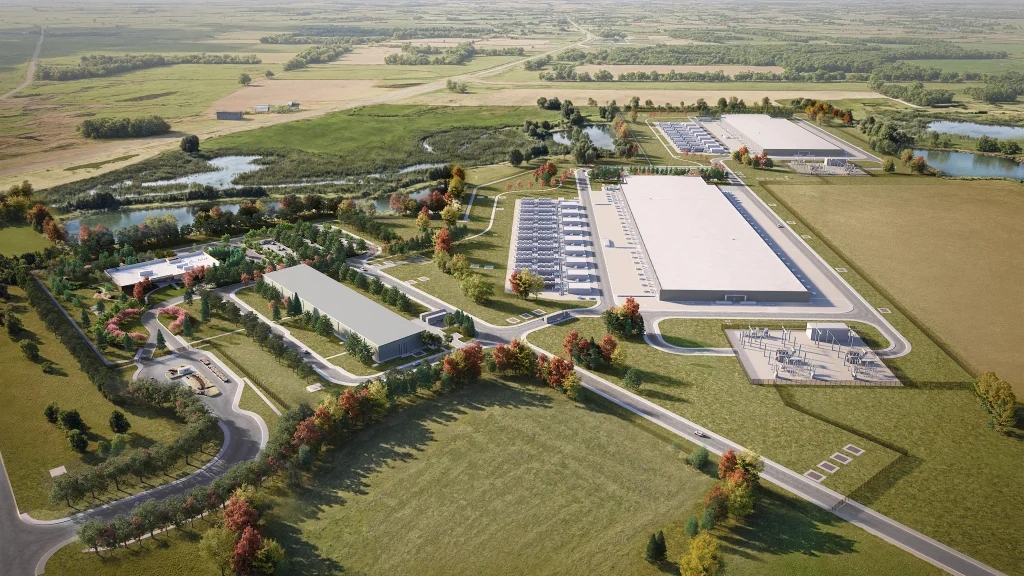
These days, a burning question for many Wisconsinites is how much water are data centers going to consume. “The top water user (and loser through evaporation) in Wisconsin is energy production,” says Freihoefer. “We anticipate, based on what we have observed from the three hyper-scale data centers under development in Wisconsin, that data centers are going to need a lot of energy.”
“With the current technology, if data centers use closed-loop technology to lower water usage on site, they end up using more energy for cooling purposes, and that comes at a water cost too,” Freihoefer continues. “In this way, closed-loop technology is misleading as a way to reduce water usage because this additional energy for cooling means power plants will need to use more water to cool electrical generation at the source. We are currently trying to understand how much water is being used and lost across the state from the power plants that exist, and where and what type of additional power generation may be needed to support the predicted Wisconsin data center requirements. We continue to track existing and emerging water uses to ensure the sustainable use of Wisconsin’s water resources now and into the future.”
WHAT PRIVATE WELL OWNERS NEED TO KNOW ABOUT GEOLOGY
The geology of your area of the state can affect your ground water. The Wisconsin Geological and Natural History Survey that Swanson leads, explores our state’s aquifers (geologic materials that store and transmit groundwater). The properties of your aquifer determine how much water it can hold, how quickly water flows through it, and how easily the groundwater can become contaminated. We know much of Wisconsin was glaciated, which left a sand and gravel aquifer closest to the surface. “The thickness of that sand and gravel aquifer varies depending on the depth down to the bedrock,” Swanson says. “On our website, we have a page that gives a 3-D view state-wide of the sand and gravel and the layers below.”
To understand the groundwater in your area, it helps to be aware of the basic water cycle that feeds it. Our groundwater starts as rain or snow, which infiltrates down through the soil to the water table at the top of an aquifer. The threat of contaminants reaching an aquifer can be seasonal. “Not all of the precipitation makes it to the water table,” Swanson says. “Some gets evaporated, or transpired, by plants through their leaves, but in the spring before plants start growing, and in the fall after plants die or go dormant, we don’t have this evapo-transpiration, and those are the periods of highest groundwater recharge.” These are times when aquifers can be especially vulnerable to contaminants.
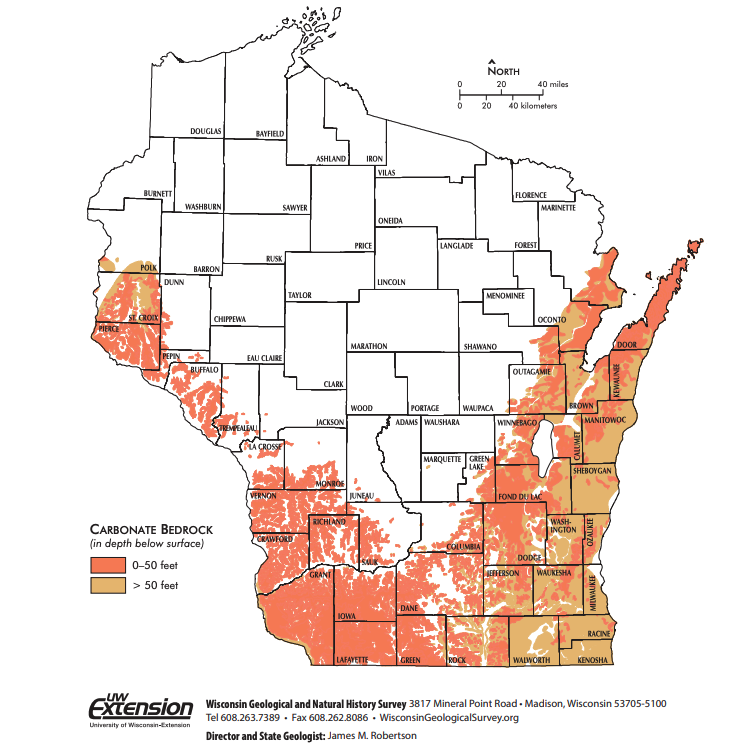
the land surface are particularly vulnerable to
groundwater contamination. Graphic courtesy of the Wisconsin DNR.
According to Cayla Cavey, Groundwater Education Specialist, UW-Stevens Point, groundwater flow is driven by gravity and pressure, and takes the path of least resistance, which typically means from higher to lower surface elevations. “A topographic map can provide a rough idea of the water table elevation underneath,” says Cavey.
“When it comes to contamination from land use practices, the likelihood of a well being influenced depends on the position of the well relative to the direction of groundwater flow, local geology, and well construction. In some instances, there may be a confining layer of geologic material that acts as a barrier, or if the well is deep enough, it may be pulling water from further away.”
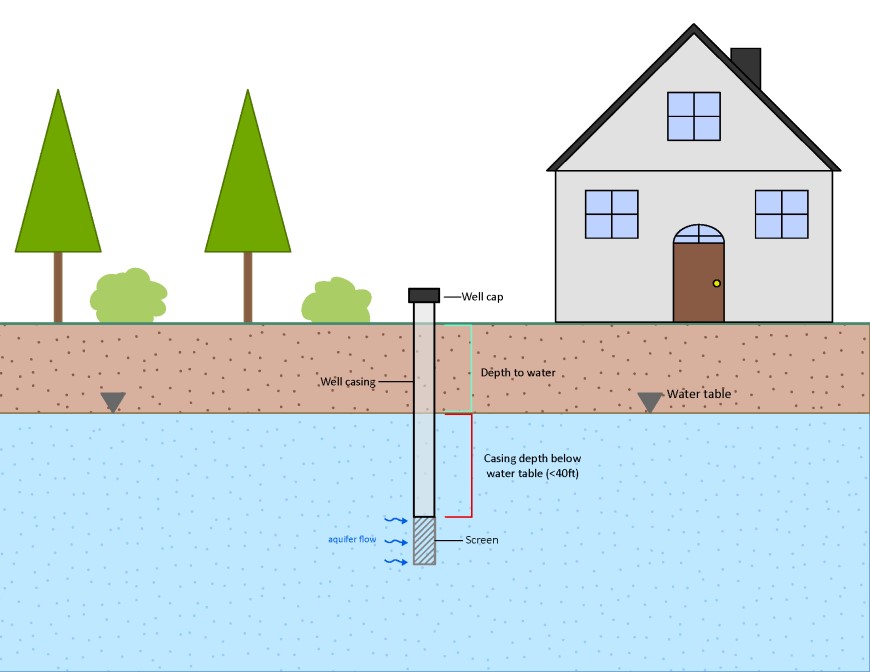
In most of Wisconsin, groundwater only moves a few feet each day. However, aquifers in carbonate (karst) bedrock are particularly at risk to contamination. Ground water flow can move through this bedrock at speeds of tens to hundreds of feet per day, and carbonate rocks are not great at filtering out contaminants. Check out this map of where carbonate bedrock occurs in Wisconsin.
COMMON WATER CONTAMINANTS
NITRATE: “The biggest contaminant in Wisconsin ground water caused by human activity is nitrate,” says Cavey. Studies estimate that at least ten percent of private wells in Wisconsin have high levels of nitrate, which is unsafe for anyone with thyroid problems or certain cancers. It is especially dangerous for pregnant women and babies less than six months old.
Common sources of nitrate include nitrogen fertilizers, manure, and septic systems. Nitrate dissolves easily in water. Wells most at risk will be those near farm fields, barnyards, feedlots, septic tanks, municipal wastewater treatment systems, and “sludge” spreading sites, according to the WDNR. The susceptibility of a given well to elevated nitrate also depends on the well’s construction and local geology.
ARSENIC: Arsenic occurs naturally in certain bedrock in Wisconsin. It cannot be smelled or tasted, but long-term exposure to drinking water containing arsenic can increase risks of skin, bladder, lung, liver, colon, and kidney cancer, as well as other health risks. Arsenic is more common in wells near fractured bedrock in southeastern Wisconsin.
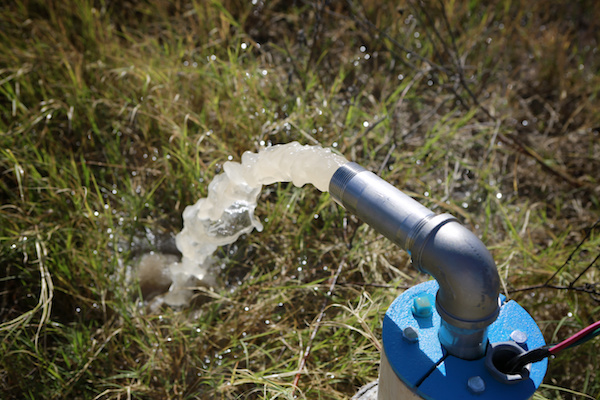
MANGANESE: Also naturally occurring in Wisconsin bedrock, manganese in small amounts is essential to forming healthy bones, and healing wounds. But high levels of manganese can affect the nervous system, impact reproduction and damage kidneys. Manganese may be in your water if it has a brown or rust-black color, causes staining of faucets, sinks, or laundry, or if it has an off taste or odor. For more information on locations of high level of manganese, check here.
ESCHERICHIA COLI (E. coli): E. coli, a type of coliform bacteria, gets into our drinking water through runoff carrying fecal waste from poor livestock farming practices, inadequate wastewater treatment, or failing septic systems. Exposure can cause vomiting, fever, or diarrhea, and can be dangerous for children and the elderly. You should have your water tested for E. coli if: the taste, color, or odor change suddenly; your water turns cloudy after a heavy rain, or flooding happens near the wellhead, or; if people drinking your water experience symptoms.
Many of these contaminants can be managed by installing a reverse osmosis system which forces water through a series of micro-porous filters that allow only relatively small water molecules through, while trapping larger contaminants.
HOW OLD IS YOUR WELL, AND HOW LONG HAS IT BEEN SINCE IT WAS LAST TESTED?
Most wells last 20 to 30 years or more, says Cavey. “I’ve seen a lot of wells that are working fine that were drilled in the 1950s, but also some 30-year old wells that need to be replaced. Over time, well casings can age and rust. How fast can depend on the type of casing and how corrosive the groundwater is in the area.” Cavey estimates it can cost from under $10,000 to over $50,000 to drill a new well, depending on how deep the water table is. Casing material can make a difference. Polyvinyl chloride (PVC) is becoming more common, and it costs less than carbon steel.
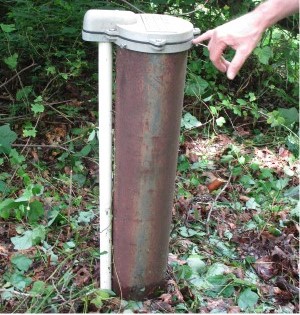
Photo credit: Wisconsin DNR
Municipal wells are tested rigorously and regularly, but responsibility for testing a private well falls on the owner. “If you want to improve your water quality,” says Cavey, “start by testing annually for coliform bacteria and nitrate. Also check for arsenic and manganese at least once. If you are in a home built before the 1980s — you may want to do a lead test, and maybe copper and zinc, from older plumbing material choices, especially if you are seeing signs of corrosive water. There are other beneficial tests to do, but these are the most common recommendations.
“You can have your water tested at the UW-Stevens Point Water Lab, where we have a homeowner package that includes bacteria and nitrate along with about six other tests of overall water quality for about $78. There are more comprehensive packages that get into the $300 to $400 range, but most people are going to be spending between $50 and $200.” The WDNR has a list of approved laboratories you can choose from as well. Once you’ve selected a lab and ordered your test, bottles and instructions on how to collect and return your sample will be shipped to you.
It’s easy to forget about your well when you fill your glass at the tap. Like the groundwater it reaches into, it is silent. But the abundant and life-sustaining nature of our water resource in Wisconsin is extraordinary, and as Ben Franklin suggested long ago, we have a lot to lose if it goes bad. A number of state agencies are also quietly involved. As Freihoefer reflects, “On a statewide level, the Wisconsin Geological and Natural History Survey supplies information about our aquifers, The UW-Stevens Point Center for Watershed Science and Education does really great water quality lab work, and the WDNR regulates to protect our groundwater.”
But, as a private well owner, knowing what is coming out of your tap, is ultimately up to you.